Your Dashboard Has Everything. Except What You’re Looking For.
Cars have more entertainment than ever. So why is finding something to listen to getting harder?
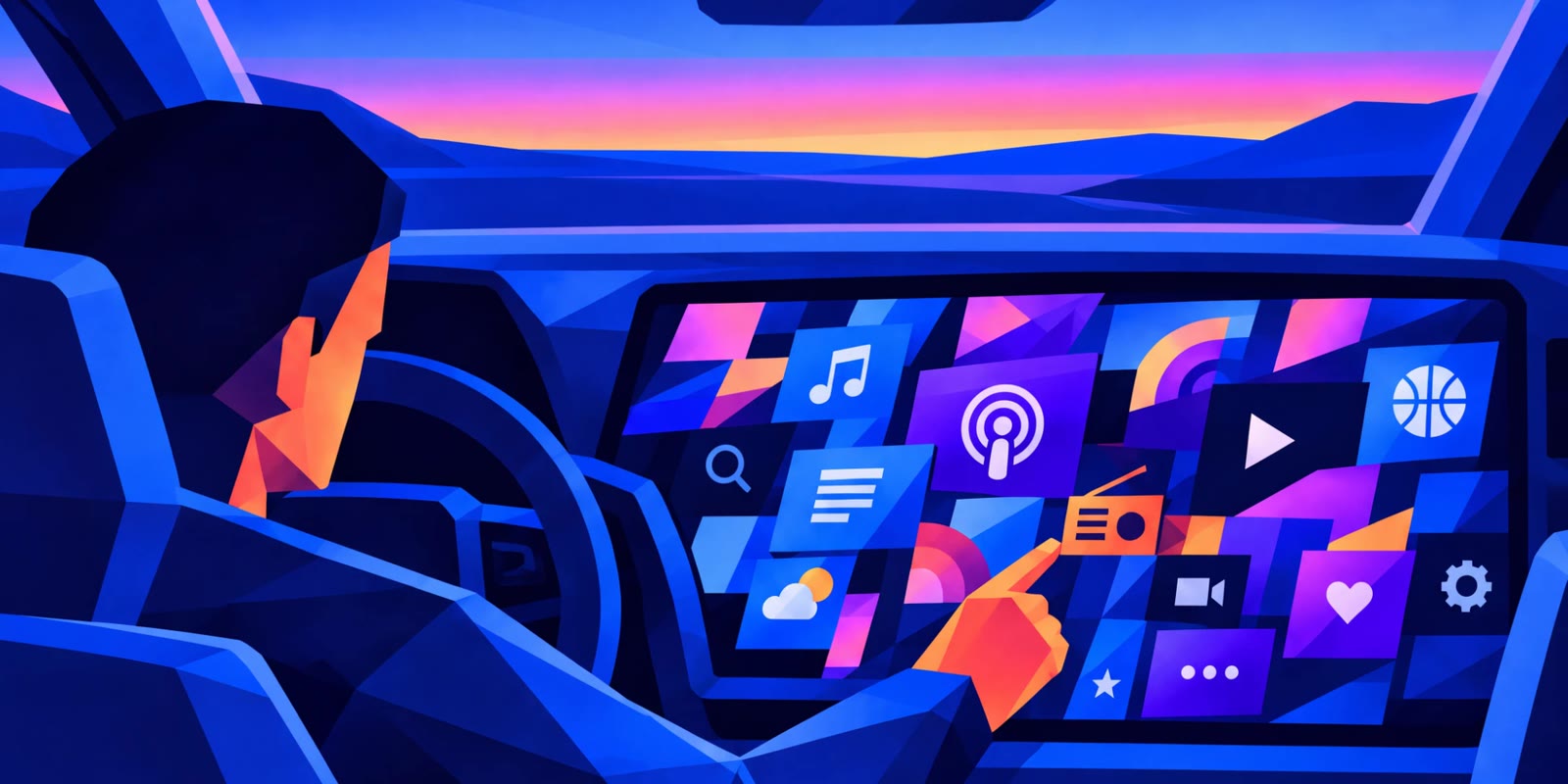
Somewhere behind the podcast app, the streaming services, and a grid of colorful tiles is the radio station you listen to every morning.
You know the station. You just don’t know which menu it’s in.
Welcome to the modern dashboard, where you can stream music from halfway around the world but might need three taps to hear what’s happening down the street.
It’s an odd trade-off. Automakers have spent years bringing more entertainment into the vehicle, giving drivers access to an enormous selection of music, news, sports, podcasts, and live radio. Yet as the choices multiply, even the most familiar listening habits can become surprisingly complicated.
And the research suggests this is more than a minor inconvenience.
Radio is still popular. Finding it is another story.
According to Edison Research’s Q1 2026 Share of Ear study, AM/FM radio, whether heard over the air or streamed, accounts for 55% of all in-car audio listening time. Streaming accounts for 16%, with podcasts, satellite radio, YouTube, and other audio formats making up the remainder.
Meanwhile, Quu’s 2026 In-Vehicle Visuals Report found that all 100 of the best-selling new vehicle models it examined in the United States include AM/FM radio. Yet only 35% have a dedicated radio button or widget in their infotainment interface. Fewer than one in ten retain a physical radio button.
Radio hasn’t gone away. It’s just had to make room for everything else.
And there’s a lot of everything else.
Built-in streaming apps now appear in 53% of the vehicle models Quu examined, up from 20% in its 2024 study. More content is moving directly into the dashboard, giving automakers new ways to deliver entertainment without relying on a driver’s smartphone.
That’s progress. But it also raises a question worth asking: At what point does adding more choice make the experience harder to navigate?
Nobody gets into a car wanting to open an app.
Imagine you want to listen to a particular football game.
It might be available on a local AM station, through an internet radio service, or inside a dedicated sports app. Depending on the vehicle, finding it could mean searching several different places.
But you didn’t get into your car thinking about content providers, distribution rights, or streaming platforms.
You wanted to hear the game.

The same goes for someone looking for a favorite podcast, a particular artist, or the local news.
The problem isn’t the content. It’s the way we’ve organized access to it.
Broadcast radio, streaming music, and podcasts may rely on different technologies, but the driver’s intention doesn’t change depending on where the content originates.
A favorite is a favorite. A search is a search.
Why should finding a radio station feel fundamentally different from finding a podcast?
For automakers, this presents an interesting design challenge. The dashboard needs to accommodate a growing number of entertainment sources without turning every new integration into another destination the driver has to learn.
The opportunity is to make each new source feel like part of one experience, not one more place to look.
Keep what works. Make room for what’s next.
Of course, bringing media sources together doesn’t mean treating them as interchangeable.
Traditional radio has advantages worth preserving.
In a May 2026 Nielsen study conducted in partnership with iHeart, more than seven in ten surveyed recent and prospective vehicle buyers described AM/FM radio as an essential feature. Approximately half said they would refuse to purchase a vehicle without it.
That preference isn’t simply nostalgia.
Broadcast radio provides access to local news, traffic, weather, and familiar programming without a subscription, a login, or a mobile data connection. It also plays an important role in delivering emergency information.
Streaming opens up an entirely different world. A driver can listen to a hometown station from across the country, discover a new artist, or pick up a podcast exactly where they left off.
These are complementary experiences, and a well-designed media platform should make the most of both.
Consider a driver searching for a favorite radio station. If it’s available through the vehicle’s tuner and an internet stream, an integrated system could help select the appropriate source based on reception, connectivity, and content availability.
The technologies would remain distinct. Terrestrial broadcast would retain its advantages, while internet streaming could extend the range of available programming.
The driver would simply find the station.
That’s the kind of simplicity worth designing for.
More entertainment. Fewer boundaries.
At iM Media Labs, we’re building around a straightforward idea: entertainment should be organized around what people want to hear, not the technology that delivers it.
The iM Media Hub brings radio, streaming music, podcasts, news, sports, and other entertainment together within a unified, vehicle-native platform. Automakers can adapt the experience to their own brands while bringing content from multiple providers into a consistent environment.
Our recently announced partnership with Stingray to integrate TuneIn will expand that offering with more than 100,000 radio stations, alongside live sports, news, music, and podcasts. The integration is designed to make TuneIn content available directly through the vehicle, without requiring smartphone projection.
But the size of the catalog is only half the story.
What matters is whether someone can actually find what they want to listen to. That’s why the iM Media Hub brings content from different providers into one experience, with personalized recommendations to help drivers discover what’s next. Existing TuneIn listeners will find their Favorites and Recently Played already waiting in the vehicle, so they can pick up right where they left off.
For automakers, bringing content together creates an opportunity to deliver a more cohesive entertainment experience while maintaining control over how that experience is presented and evolves.
For broadcasters and other content providers, it creates new opportunities for discovery. A station or podcast no longer has to rely exclusively on someone navigating to its dedicated app.
And for drivers, it means less time figuring out where something lives and more time enjoying it.
The next big thing might be making things simpler.
The automotive industry has made extraordinary progress in expanding what’s possible inside the vehicle.
We can stream live sports, discover music tailored to our tastes, and access programming from practically anywhere. Entertainment that once required several devices and subscriptions can now live directly in the dashboard.
There’s no reason to slow that progress.
But perhaps it’s time to pay just as much attention to the experience of finding something as we do to making it available.
That means keeping familiar content within easy reach, making discovery more intuitive, and finding better ways to bring different media sources together.
More choice is a wonderful thing. Making people work harder to enjoy it isn’t.
After all, a car that can take you almost anywhere shouldn’t make you hunt for the station around the corner.