The Opposite of Bespoke Isn’t Generic.
Automakers don’t need to own every line of media software to own the experience. They need control over the choices drivers actually see and hear.
Rent a car you’ve never driven before and start it.
Before you learn where the climate controls live, the media system has already introduced itself. Maybe it resumes a local station. Maybe it opens on familiar favorites. Maybe it presents the same anonymous grid you’ve seen in three other cars.
That first moment says something about the vehicle. Or it says nothing at all.
Automakers spend enormous effort making a cabin feel unmistakably theirs. Materials, lighting, typography, motion, sound design—even the weight of a switch can carry the brand.
The media experience belongs in that same conversation.
The dashboard is already a brand surface.
Audacy’s 2026 Connected Car Study reports that more than half of connected-car drivers use the dashboard to control audio, putting it nearly on par with calls and navigation and well ahead of messaging, video, calendars, and games.
If audio is one of the dashboard’s core functions, the media experience isn’t just a utility sitting behind the brand. It’s part of how the brand shows up.
That makes a shared media platform sound risky. If several automakers use the same underlying technology, won’t every dashboard eventually feel the same?
It’s a fair question. But it assumes ownership and control are the same thing.
They aren’t.
Owning the code is not the same as owning the experience.
Drivers don’t experience a codebase. They experience what the system does: what starts playing, what gets the first row, how favorites are treated, which services are included, what gets recommended, and what changes across trims or regions.
An automaker can own every line of its media software and still make those decisions slowly—or barely at all. Another can build on a shared foundation and retain deep control over the things a customer actually notices.
That’s the more useful distinction: not bespoke versus shared, but rigid versus configurable.
A shared platform shouldn’t decide the personality. It should make the personality easier to express.
Brand lives in the choices.
Consider the cold start. Opening on local morning radio creates a different impression than opening on a road-trip mix, a recently played podcast, or a wall of app icons. None is inherently right or wrong. Each says something.
The same is true of programming. A curated station has a point of view: what leads, what never appears, how familiar tracks are balanced with discovery, and how the mood changes over time.

Then there are choices that sound operational but are just as much part of the brand. Which content is free? What requires an account? Is local radio prominent or buried? Does a premium trim get a different content mix? Does one region get different priorities from another?
Put those decisions together and two vehicles using the same underlying media infrastructure can feel completely different.
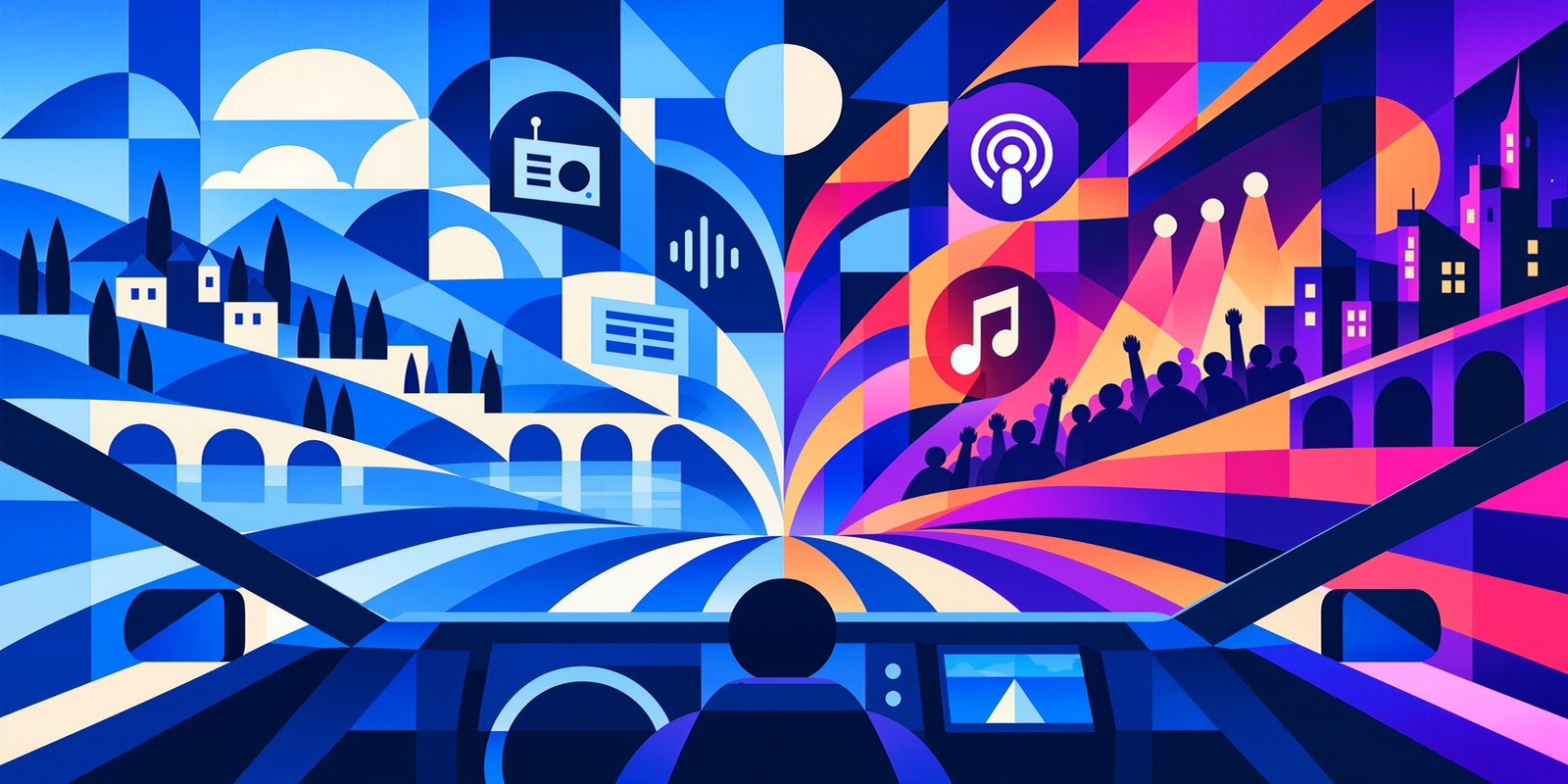
Picture two vehicles running on the same media platform. Start the rugged pickup, and it opens on the local morning show, with weather, traffic, and Friday night’s game a tap away—no account required. Start the luxury sedan, and it opens on a calm curated mix, with premium podcasts up front and the app grid nowhere in sight.
Same infrastructure. Two different personalities.
Control also means being able to change.
Brand expression isn’t something an automaker decides once at launch and freezes for the life of the vehicle.
Content changes. Partnerships change. New services arrive. Consumer habits move. An automaker may want to introduce a new premium offer, change what appears first, or rethink a recommendation strategy after seeing how drivers use the system.
That raises a practical question: who can make those changes, and how long do they take?
If changing the experience for one trim requires a major engineering program, the automaker may technically own the software while having very little day-to-day control over it.

A well-designed shared platform can do the opposite.
By separating common media infrastructure from the decisions that shape the experience, it can let automakers spend less effort rebuilding the plumbing and more effort deciding what makes their product distinct.
A better test for any media platform.
When evaluating a media platform, don’t start by asking who owns the code. Ask to see the same platform configured for two different brands, side by side.
Watch the startup. Look at the first row of content. Search for the same thing. Compare favorites, recommendations, local content, and premium services.
Then ask what changes between trims and regions. Ask who can make those changes. Ask how long they take.
If the two experiences look like the same product with different logos, the platform isn’t exposing enough of what makes a brand distinct. If every meaningful change requires a new engineering project, it isn’t exposing enough control either.
Shared shouldn’t mean generic.
At iM Media Labs, we see this from both sides. We program more than 100 curated iM channels ourselves, so we know how many small decisions sit behind something that simply sounds right. A brief becomes a mood; a mood becomes a sequence of tracks; and the sequence only works when someone decides what belongs and what doesn’t.
That same principle informs the iM Media Hub. It’s designed to integrate with vehicle systems and adapt to each automaker’s brand, interface, and business model while bringing multiple media sources into one vehicle-native experience.
The point isn’t that every automaker should make the same choices. It’s that a shared platform should leave room for them to make very different ones—and to keep making them after the vehicle leaves the factory.
The opposite of bespoke isn’t generic.
It’s shared infrastructure with enough control for the brand to remain unmistakably its own.